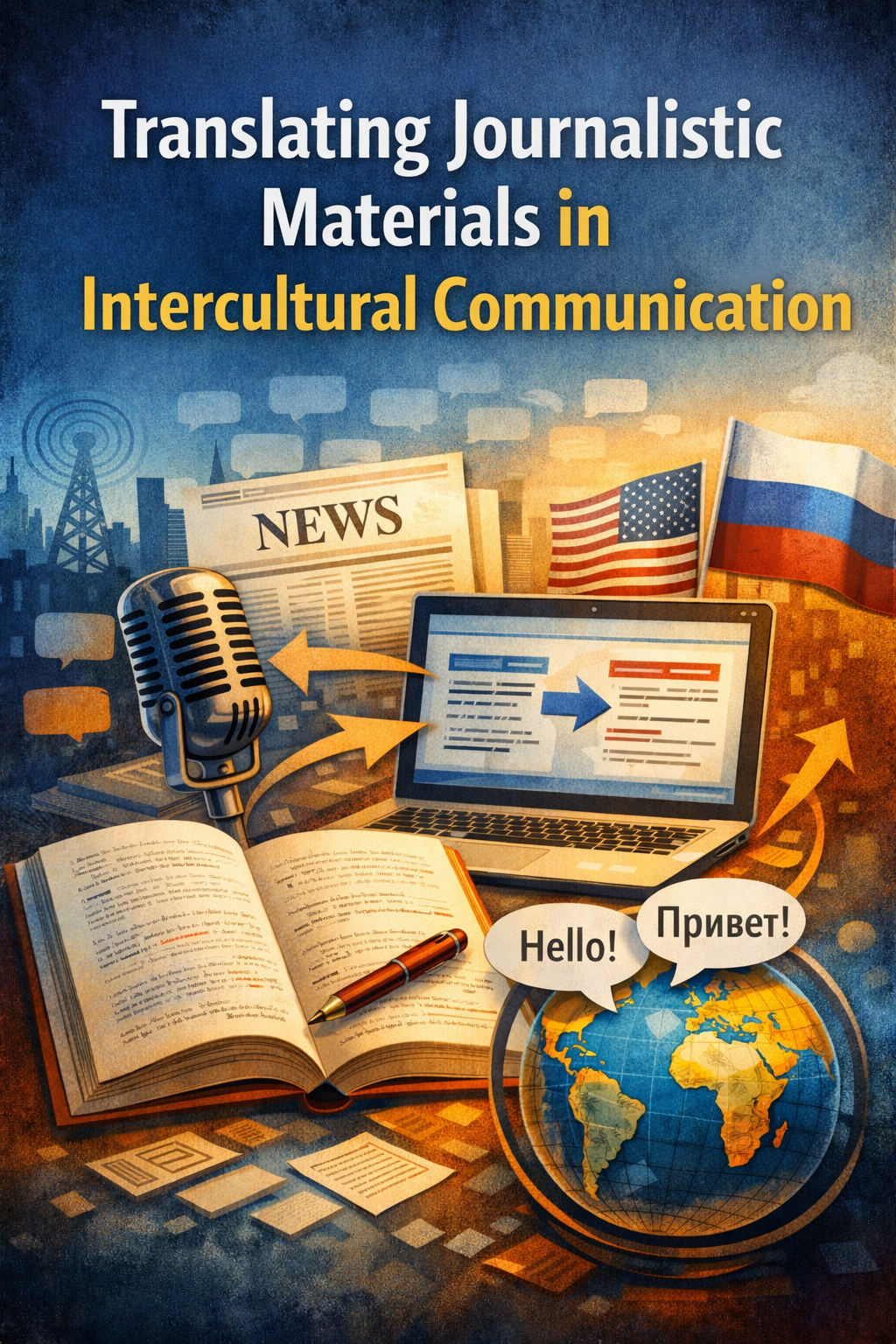
Перевод публицистических материалов занимает особое место в современной переводческой практике, поскольку публицистика непосредственно связана с актуальными общественными, политическими и культурными процессами. В условиях межкультурной коммуникации такой перевод становится не просто средством передачи информации с одного языка на другой, а важным механизмом взаимодействия различных культурных пространств. Именно поэтому переводчик публицистических текстов должен учитывать не только языковую форму оригинала, но и культурные, прагматические и коммуникативные особенности текста. Публицистические материалы ориентированы на широкую аудиторию и выполняют сразу несколько функций: информативную, оценочную, воздействующую и интерпретационную. Они сообщают факты, формируют отношение к событиям, направляют восприятие читателя и нередко отражают авторскую позицию. В связи с этим перевод публицистики требует особой точности: недостаточно передать лишь содержание текста, необходимо также сохранить его тональность, выразительность и прагматический эффект. Иначе перевод может оказаться формально правильным, но функционально неадекватным. Одной из главных трудностей перевода публицистических материалов в условиях межкультурной коммуникации является наличие культурно маркированных единиц. К ним относятся реалии, аллюзии, идиомы, прецедентные имена, общественно-политические коннотации и иные элементы, тесно связанные с культурой исходного языка. Для носителя оригинала такие единицы часто понятны без пояснений, тогда как для иноязычного читателя они могут быть неочевидными. В подобных случаях переводчик использует стратегии адаптации, пояснения или функциональной замены, чтобы сохранить доступность текста и его воздействующий потенциал. Не менее важной особенностью является необходимость передачи оценочности и авторской позиции. Публицистический текст редко бывает нейтральным: он может содержать скрытую или явную оценку, элементы иронии, критики, эмоционально окрашенную лексику, выразительные заголовки и риторические конструкции. При переводе подобных материалов важно воспроизвести не только фактологическую основу, но и отношение автора к описываемому явлению. Потеря оценочного компонента приводит к ослаблению текста и искажению его коммуникативной направленности. Существенную роль играет и прагматическая адаптация. В межкультурной коммуникации переводчик должен учитывать фоновые знания целевой аудитории, её культурный опыт, медиасреду и нормы восприятия публичного дискурса. Иногда одна и та же тема, выраженная в оригинале через привычные для одной культуры формулы, требует иной подачи в переводе. Это особенно заметно в заголовках, подзаголовках и общественно значимых комментариях, где важны краткость, выразительность и мгновенная понятность. Кроме того, перевод публицистических материалов связан с необходимостью соблюдать баланс между точностью и естественностью. С одной стороны, искажение фактов, понятий и акцентов недопустимо. С другой стороны, чрезмерная буквальность может сделать текст тяжёлым, неестественным или даже непонятным для читателя перевода. Поэтому переводчик вынужден сочетать семантическую точность с нормами целевого языка, добиваясь функциональной эквивалентности текста. Таким образом, особенности перевода публицистических материалов в условиях межкультурной коммуникации определяются сложным взаимодействием языковых, культурных и прагматических факторов. Успешный перевод требует от переводчика не только владения языками, но и способности интерпретировать культурный контекст, учитывать ожидания аудитории и сохранять воздействующую силу оригинала. В этом смысле переводчик выступает посредником не только между текстами, но и между культурами, обеспечивая полноценное понимание и эффективное коммуникативное взаимодействие. The translation of journalistic materials occupies a special place in contemporary translation practice, since journalism is directly connected with current social, political, and cultural processes. In the context of intercultural communication, such translation becomes not merely a means of transferring information from one language to another, but also an important mechanism of interaction between different cultural spaces. For this reason, the translator of journalistic texts must take into account not only the linguistic form of the original, but also the cultural, pragmatic, and communicative features of the text. Journalistic materials are addressed to a broad audience and perform several functions simultaneously: informative, evaluative, persuasive, and interpretative. They report facts, shape attitudes toward events, guide the reader’s perception, and often reflect the author’s position. Therefore, the translation of journalistic texts requires special precision: it is not enough to convey only the content of the text; it is also necessary to preserve its tone, expressiveness, and pragmatic effect. Otherwise, the translation may be formally correct but functionally inadequate. One of the main difficulties in translating journalistic materials in the context of intercultural communication is the presence of culture-specific elements. These include realia, allusions, idioms, precedent names, socio-political connotations, and other components closely connected with the culture of the source language. For readers of the original, such units are often clear without explanation, whereas for a foreign-language audience they may be unclear or even incomprehensible. In such cases, the translator uses strategies of adaptation, explanation, or functional substitution in order to preserve the accessibility of the text and its persuasive potential. Another important feature is the need to convey evaluation and the author’s position. A journalistic text is rarely neutral: it may contain explicit or implicit evaluation, irony, criticism, emotionally colored vocabulary, expressive headlines, and rhetorical constructions. When translating such materials, it is essential to reproduce not only the factual basis, but also the author’s attitude toward the phenomenon being described. The loss of the evaluative component weakens the text and distorts its communicative orientation. A significant role is also played by pragmatic adaptation. In intercultural communication, the translator must consider the background knowledge of the target audience, its cultural experience, media environment, and norms of perceiving public discourse. Sometimes the same topic expressed in the original through formulas familiar to one culture requires a different presentation in translation. This is especially evident in headlines, subheadings, and socially significant commentary, where brevity, expressiveness, and immediate clarity are crucial. In addition, the translation of journalistic materials is associated with the need to maintain a balance between accuracy and naturalness. On the one hand, distortion of facts, concepts, and emphases is unacceptable. On the other hand, excessive literalness may make the text heavy, unnatural, or even incomprehensible for the target reader. Therefore, the translator has to combine semantic precision with the norms of the target language in order to achieve the functional equivalence of the text. Thus, the specific features of translating journalistic materials in the context of intercultural communication are determined by the complex interaction of linguistic, cultural, and pragmatic factors. Successful translation requires the translator not only to have command of languages, but also to be able to interpret the cultural context, take into account the audience’s expectations, and preserve the persuasive force of the original. In this sense, the translator acts as a mediator not only between texts, but also between cultures, ensuring full understanding and effective communicative interaction.
Адрес:
Телефон:
Email:
Сайт:
Информация
Посетители, находящиеся в группе Гости, не могут оставлять комментарии к данной публикации.