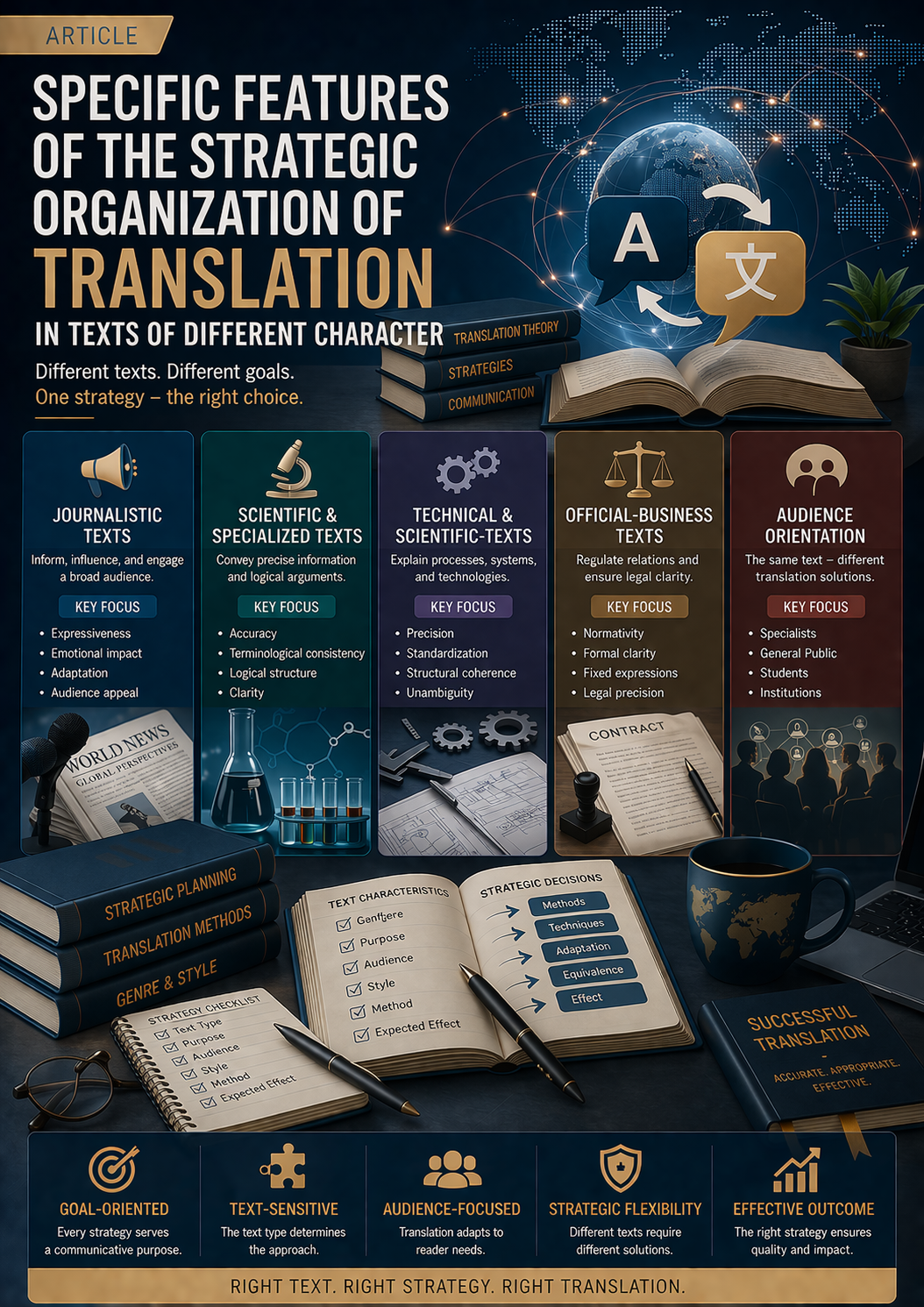
В современной теории и практике перевода всё более очевидным становится тот факт, что перевод представляет собой не механическую замену единиц одного языка единицами другого, а сложный процесс стратегической организации текста в иной языковой и культурной среде. Особенно ярко это проявляется при работе с разнохарактерными текстами, то есть с материалами, различающимися по цели, жанру, стилю, структуре и коммуникативной направленности. В таких условиях переводчик должен не просто передавать содержание, но и выстраивать систему решений, которая будет соответствовать функциональной природе конкретного текста. Под стратегической организацией перевода понимается целенаправленный выбор принципов, методов и способов межъязыковой передачи, обеспечивающих адекватное воспроизведение содержания, формы и функции оригинала. Эта организация охватывает все уровни текста: лексический, синтаксический, стилистический, прагматический и культурный. Иными словами, переводчик выстраивает не отдельные локальные решения, а общую модель работы, в которой каждый элемент подчинён общей коммуникативной задаче. Особенности стратегической организации особенно заметны при сопоставлении разных типов текстов. Так, в публицистических материалах важнейшую роль играют актуальность, оценочность, воздействие на читателя и экспрессивность. Следовательно, стратегическая организация перевода здесь строится вокруг сохранения эмоционально-прагматического эффекта текста. Переводчик использует адаптацию, экспликацию, смысловую компрессию и иные средства, позволяющие сохранить воздействующую силу оригинала. В научных, специальных и научно-технических текстах приоритеты иные. Здесь на первый план выходят точность, логическая последовательность, терминологическая однозначность и информативность. В таких случаях стратегическая организация перевода основывается на стандартизации, терминологической эквивалентности, структурной ясности и минимизации двусмысленности. Любое чрезмерно свободное решение может нарушить точность информации, а значит — снизить качество перевода. Официально-деловые тексты предъявляют ещё более строгие требования. Для них характерны нормативность, формальная чёткость, юридическая значимость и устойчивость речевых конструкций. Поэтому стратегия перевода в данном случае направлена на сохранение клишированных формул, точность формулировок и соблюдение норм делового стиля. Переводчик здесь действует в жёстко ограниченном пространстве жанровых требований. Особенность стратегической организации перевода в разнохарактерных текстах заключается также в том, что она всегда зависит от адресата. Один и тот же исходный материал может потребовать разных решений в зависимости от того, предназначен ли перевод для специалистов, широкой аудитории, студентов или официальных структур. Следовательно, стратегия перевода определяется не только типом текста, но и условиями его функционирования. Таким образом, стратегическая организация перевода в разнохарактерных текстах представляет собой гибкую, но системную модель переводческой деятельности. Она основывается на учёте функционального назначения текста, его жанровых особенностей, стилистики и адресата. Именно такой подход позволяет обеспечить точность, уместность и коммуникативную эффективность перевода в различных сферах межъязыкового общения. In modern translation theory and practice, it is becoming increasingly clear that translation is not a mechanical replacement of units of one language by units of another, but a complex process of strategic organization of the text in a different linguistic and cultural environment. This is especially evident when working with texts of different character, that is, with materials that differ in purpose, genre, style, structure, and communicative orientation. Under such conditions, the translator must not simply convey the content, but also build a system of decisions that corresponds to the functional nature of a particular text. Strategic organization of translation can be understood as the purposeful choice of principles, methods, and ways of interlingual transfer that ensure the adequate reproduction of the content, form, and function of the original. This organization covers all levels of the text: lexical, syntactic, stylistic, pragmatic, and cultural. In other words, the translator constructs not isolated local decisions, but a general model of work in which each element is subordinated to the overall communicative task. The specific features of strategic organization are especially noticeable when comparing different types of texts. In journalistic materials, for example, topicality, evaluative meaning, impact on the reader, and expressiveness play the most important role. Consequently, the strategic organization of translation here is built around preserving the emotional and pragmatic effect of the text. The translator uses adaptation, explicitation, semantic compression, and other means that make it possible to preserve the persuasive force of the original. In scientific, specialized, and scientific-technical texts, priorities are different. Here, precision, logical sequence, terminological unambiguity, and informativeness come to the forefront. In such cases, the strategic organization of translation is based on standardization, terminological equivalence, structural clarity, and the minimization of ambiguity. Any excessively free decision may disrupt the accuracy of information and therefore reduce the quality of translation. Official-business texts impose even stricter requirements. They are characterized by normativity, formal clarity, legal significance, and stability of formulaic constructions. Therefore, the translation strategy in this case is aimed at preserving fixed formulas, accuracy of wording, and compliance with the norms of business style. Here, the translator operates within a rigidly limited space of genre requirements. Another specific feature of the strategic organization of translation in texts of different character is that it always depends on the target audience. The same source material may require different decisions depending on whether the translation is intended for specialists, the general public, students, or official institutions. Consequently, the translation strategy is determined not only by the type of text, but also by the conditions of its functioning. Thus, the strategic organization of translation in texts of different character is a flexible but systematic model of translation activity. It is based on taking into account the functional purpose of the text, its genre features, style, and audience. It is precisely this approach that makes it possible to ensure the accuracy, appropriateness, and communicative effectiveness of translation in various spheres of interlingual communication.
Адрес:
Телефон:
Email:
Сайт:
Информация
Посетители, находящиеся в группе Гости, не могут оставлять комментарии к данной публикации.