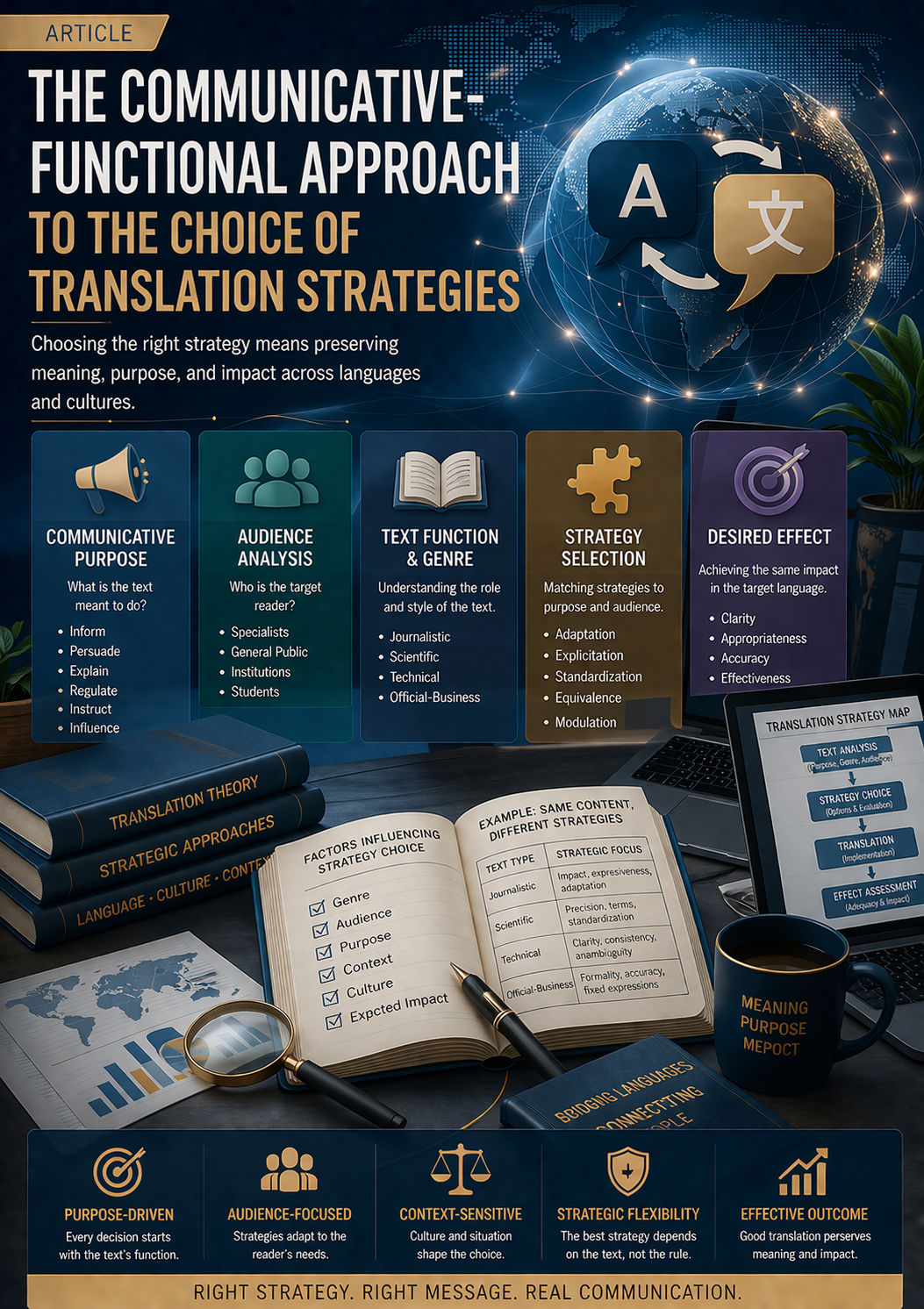
В современной теории перевода всё более значимое место занимает коммуникативно-функциональный подход, согласно которому перевод рассматривается не как простая замена языковых единиц одного языка единицами другого, а как процесс передачи смысла с учётом функции текста, цели общения и особенностей адресата. Такой подход позволяет рассматривать перевод как разновидность межъязыковой коммуникации, в которой важна не только точность содержания, но и то, какой эффект текст производит на получателя в новой языковой среде. Сущность коммуникативно-функционального подхода состоит в том, что при выборе переводческой стратегии переводчик ориентируется прежде всего на назначение текста. Иными словами, важно определить, какую роль текст выполняет: информирует, убеждает, объясняет, регулирует, инструктирует или воздействует эмоционально. Именно эта функция становится основой для отбора языковых средств и переводческих решений. Следовательно, в центре внимания оказывается не буквальное совпадение формы, а сохранение коммуникативной ценности текста. Выбор переводческих стратегий в рамках данного подхода зависит от нескольких факторов. К ним относятся жанр текста, его функциональный стиль, целевая аудитория, прагматическая установка автора, культурный контекст и предполагаемый результат восприятия. Один и тот же фрагмент может требовать разных решений в зависимости от того, переводится ли он для специалистов, широкой аудитории, официального учреждения или учебной среды. Поэтому переводчик должен учитывать не только языковую структуру оригинала, но и условия его функционирования. Особенно ярко коммуникативно-функциональный подход проявляется при переводе текстов разных типов. В публицистических текстах важны воздействующая функция, выразительность и оценочность, поэтому здесь уместны стратегии прагматической адаптации, экспликации и сохранения эмоционально-оценочной лексики. В научных и специальных текстах на первый план выходят точность, логичность и терминологическая последовательность, что требует стратегий стандартизации, терминологической эквивалентности и функциональной ясности. В официально-деловых текстах особую роль играют нормативность, формальная чёткость и юридическая однозначность, поэтому переводчик ориентируется на максимальную точность и сохранение клишированных конструкций. Коммуникативно-функциональный подход важен и тем, что он позволяет переводчику избежать формального, буквального перевода в тех случаях, когда он не обеспечивает адекватного восприятия текста. Иногда для сохранения функции оригинала необходимо изменить структуру высказывания, уточнить скрытый смысл, адаптировать реалии или ослабить элементы, которые могут быть непонятны адресату. В этом проявляется гибкость переводческой стратегии, направленной на достижение полноценной межъязыковой коммуникации. Таким образом, коммуникативно-функциональный подход к выбору переводческих стратегий позволяет рассматривать перевод как целенаправленный и осмысленный процесс. Он ориентирует переводчика на функцию текста, коммуникативную ситуацию и адресата, что делает перевод более точным, уместным и эффективным. Именно такой подход обеспечивает не только передачу содержания, но и сохранение роли текста в новой культурно-языковой среде. In modern translation theory, the communicative-functional approach is gaining increasing importance. According to this approach, translation is viewed not as a simple substitution of linguistic units of one language by those of another, but as a process of meaning transfer that takes into account the function of the text, the purpose of communication, and the characteristics of the recipient. Such an approach makes it possible to consider translation as a form of interlingual communication in which not only the accuracy of content matters, but also the effect the text produces on the recipient in a new linguistic environment. The essence of the communicative-functional approach lies in the fact that, when choosing a translation strategy, the translator is guided primarily by the purpose of the text. In other words, it is important to determine what role the text performs: whether it informs, persuades, explains, regulates, instructs, or produces an emotional impact. It is precisely this function that becomes the basis for selecting linguistic means and translation decisions. Consequently, the focus is placed not on the literal coincidence of form, but on preserving the communicative value of the text. The choice of translation strategies within this approach depends on several factors. These include the genre of the text, its functional style, the target audience, the author’s pragmatic orientation, the cultural context, and the expected result of reception. The same fragment may require different solutions depending on whether it is translated for specialists, the general public, an official institution, or an educational setting. Therefore, the translator must take into account not only the linguistic structure of the original, but also the conditions of its functioning. The communicative-functional approach is especially clearly manifested in the translation of different types of texts. In journalistic texts, the persuasive function, expressiveness, and evaluative meaning are important, so strategies such as pragmatic adaptation, explicitation, and preservation of emotionally and evaluatively marked vocabulary are appropriate. In scientific and specialized texts, priority is given to precision, logical coherence, and terminological consistency, which requires strategies of standardization, terminological equivalence, and functional clarity. In official-business texts, normativity, formal clarity, and legal unambiguity play a special role; therefore, the translator is guided by maximum precision and the preservation of formulaic constructions. The communicative-functional approach is also important because it allows the translator to avoid formal, overly literal translation in cases where such translation does not ensure adequate reception of the text. Sometimes, in order to preserve the function of the original, it is necessary to change the structure of the utterance, clarify implicit meaning, adapt realia, or reduce elements that may be incomprehensible to the target audience. This demonstrates the flexibility of a translation strategy aimed at achieving полноценная interlingual communication. Thus, the communicative-functional approach to the choice of translation strategies makes it possible to view translation as a purposeful and meaningful process. It directs the translator’s attention to the function of the text, the communicative situation, and the target audience, which makes translation more accurate, appropriate, and effective. It is precisely this approach that ensures not only the transfer of content, but also the preservation of the role of the text in a new cultural and linguistic environment.
Адрес:
Телефон:
Email:
Сайт:
Информация
Посетители, находящиеся в группе Гости, не могут оставлять комментарии к данной публикации.