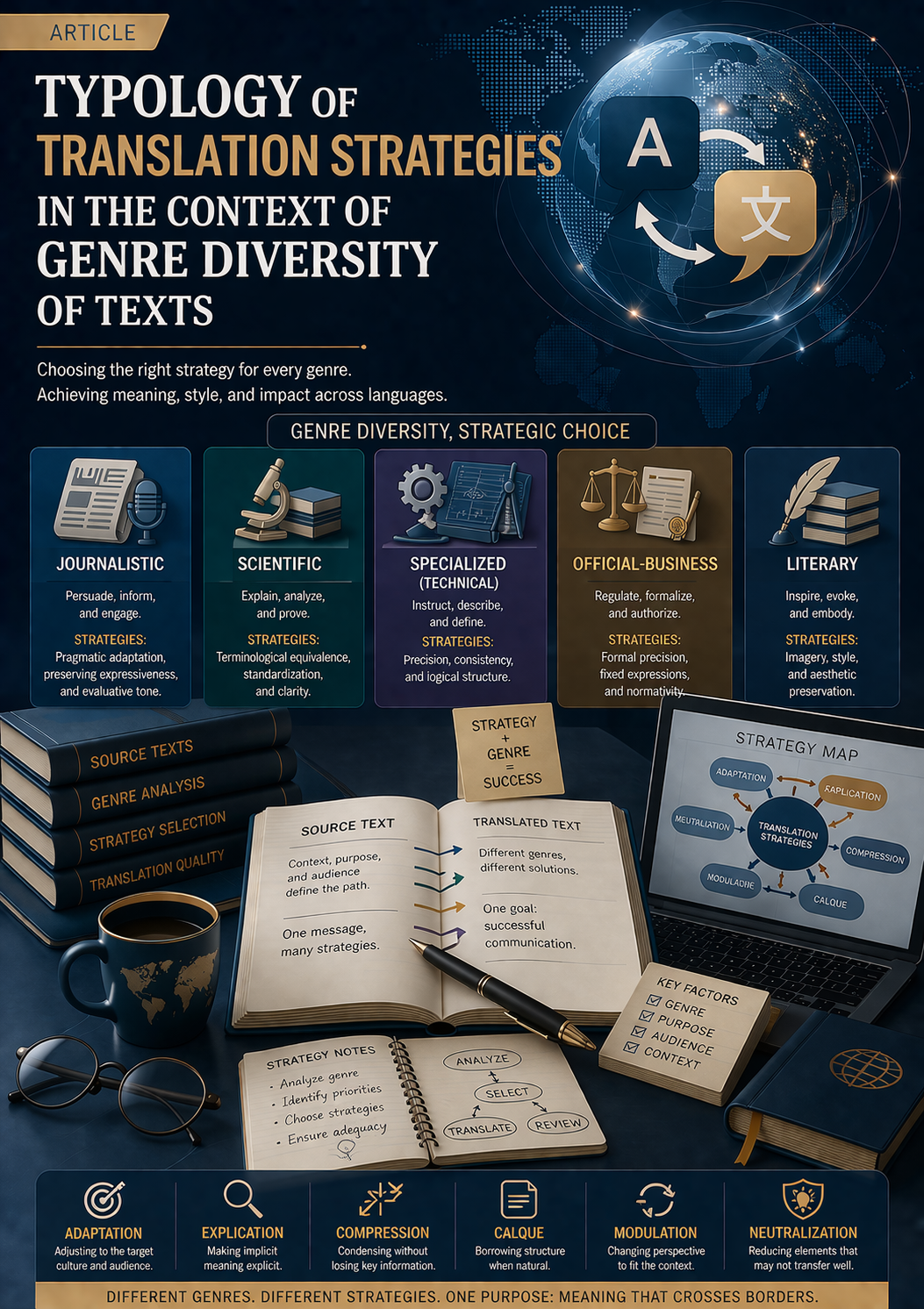
В современной теории перевода проблема типологии переводческих стратегий приобретает особую значимость в связи с жанровым разнообразием текстов. Переводчик работает с материалами, которые различаются по коммуникативной цели, структуре, стилистике, степени терминологической насыщенности и способу воздействия на адресата. Именно поэтому перевод не может опираться на единый универсальный алгоритм: он требует выбора стратегии, соответствующей жанру текста и условиям его функционирования в новой языковой среде. Под переводческой стратегией обычно понимается общий принцип организации перевода, определяющий направление переводческих решений. Типология переводческих стратегий позволяет систематизировать подходы, применяемые переводчиком при работе с текстами разных жанров, и показать, какие именно стратегии становятся приоритетными в зависимости от функциональной природы текста. Такая классификация важна как для теории перевода, так и для практики, поскольку помогает выработать осознанную модель работы с различными типами дискурса. Одним из оснований типологии является степень ориентации на исходный текст или на адресата перевода. В первом случае переводчик стремится максимально сохранить структуру, содержание и формальные особенности оригинала. Во втором случае на первый план выходит адаптация текста к нормам языка перевода, культурному контексту и ожиданиям аудитории. Эти два полюса не исключают друг друга, а образуют спектр стратегий, между которыми переводчик выбирает в зависимости от жанра и коммуникативной задачи текста. В условиях жанрового разнообразия особенно чётко выделяются стратегии, характерные для разных типов текстов. В публицистических жанрах важны прагматическая адаптация, сохранение экспрессивности, передача оценочной лексики и воздействующего потенциала текста. В научных и специальных жанрах доминируют стратегии терминологической эквивалентности, стандартизации, логической ясности и однозначности. В официально-деловых жанрах приоритет получают формальная точность, сохранение клишированных конструкций и нормативность языка. Художественные тексты, в свою очередь, требуют более сложного сочетания стратегий, связанных с передачей образности, индивидуального стиля и эстетического воздействия. Типология переводческих стратегий также может строиться по характеру преобладающих переводческих действий. К ним относятся стратегии адаптации, компрессии, экспликации, калькирования, модуляции, нейтрализации или, напротив, сохранения экспрессивных средств. Однако любая из этих стратегий должна рассматриваться не изолированно, а в связи с жанровыми особенностями текста. Один и тот же приём может быть оправдан в одном жанре и неуместен в другом. Таким образом, типология переводческих стратегий в условиях жанрового разнообразия текстов показывает, что перевод представляет собой гибкую и функционально обусловленную деятельность. Выбор стратегии зависит от жанра, цели текста, адресата и коммуникативной ситуации. Именно системное понимание стратегий позволяет переводчику создавать тексты, которые не только точно передают содержание оригинала, но и сохраняют его жанровую специфику и коммуникативную ценность. In modern translation theory, the problem of the typology of translation strategies has become especially significant due to the genre diversity of texts. A translator works with materials that differ in communicative purpose, structure, style, degree of terminological density, and manner of influencing the recipient. For this reason, translation cannot rely on a single universal algorithm: it requires the selection of a strategy that corresponds to the genre of the text and the conditions of its functioning in a new linguistic environment. A translation strategy is generally understood as a broad principle of organizing translation that determines the direction of translation decisions. The typology of translation strategies makes it possible to systematize the approaches used by the translator when working with texts of different genres and to show which strategies become dominant depending on the functional nature of the text. Such a classification is important both for translation theory and for practice, since it helps to develop a conscious model of working with different types of discourse. One basis for this typology is the degree of orientation toward the source text or toward the target audience. In the first case, the translator seeks to preserve the structure, content, and formal features of the original as fully as possible. In the second case, priority is given to adapting the text to the norms of the target language, the cultural context, and the expectations of the audience. These two poles do not exclude each other, but form a spectrum of strategies from which the translator chooses depending on the genre and communicative purpose of the text. In conditions of genre diversity, the strategies characteristic of different text types are especially clearly distinguished. In journalistic genres, pragmatic adaptation, preservation of expressiveness, rendering of evaluative vocabulary, and maintenance of the text’s persuasive potential are important. In scientific and specialized genres, dominant strategies include terminological equivalence, standardization, logical clarity, and unambiguity. In official-business genres, priority is given to formal precision, preservation of formulaic constructions, and normative language. Literary texts, in turn, require a more complex combination of strategies connected with rendering imagery, individual style, and aesthetic effect. The typology of translation strategies may also be based on the nature of the predominant translation actions. These include strategies of adaptation, compression, explicitation, calque, modulation, neutralization, or, on the contrary, preservation of expressive means. However, each of these strategies must be considered not in isolation, but in connection with the genre-specific features of the text. The same technique may be justified in one genre and inappropriate in another. Thus, the typology of translation strategies in the context of genre diversity of texts shows that translation is a flexible and functionally determined activity. The choice of strategy depends on the genre, purpose of the text, target audience, and communicative situation. It is precisely the systematic understanding of strategies that enables the translator to create texts that not only accurately convey the content of the original, but also preserve its genre specificity and communicative value.
Адрес:
Телефон:
Email:
Сайт:
Информация
Посетители, находящиеся в группе Гости, не могут оставлять комментарии к данной публикации.