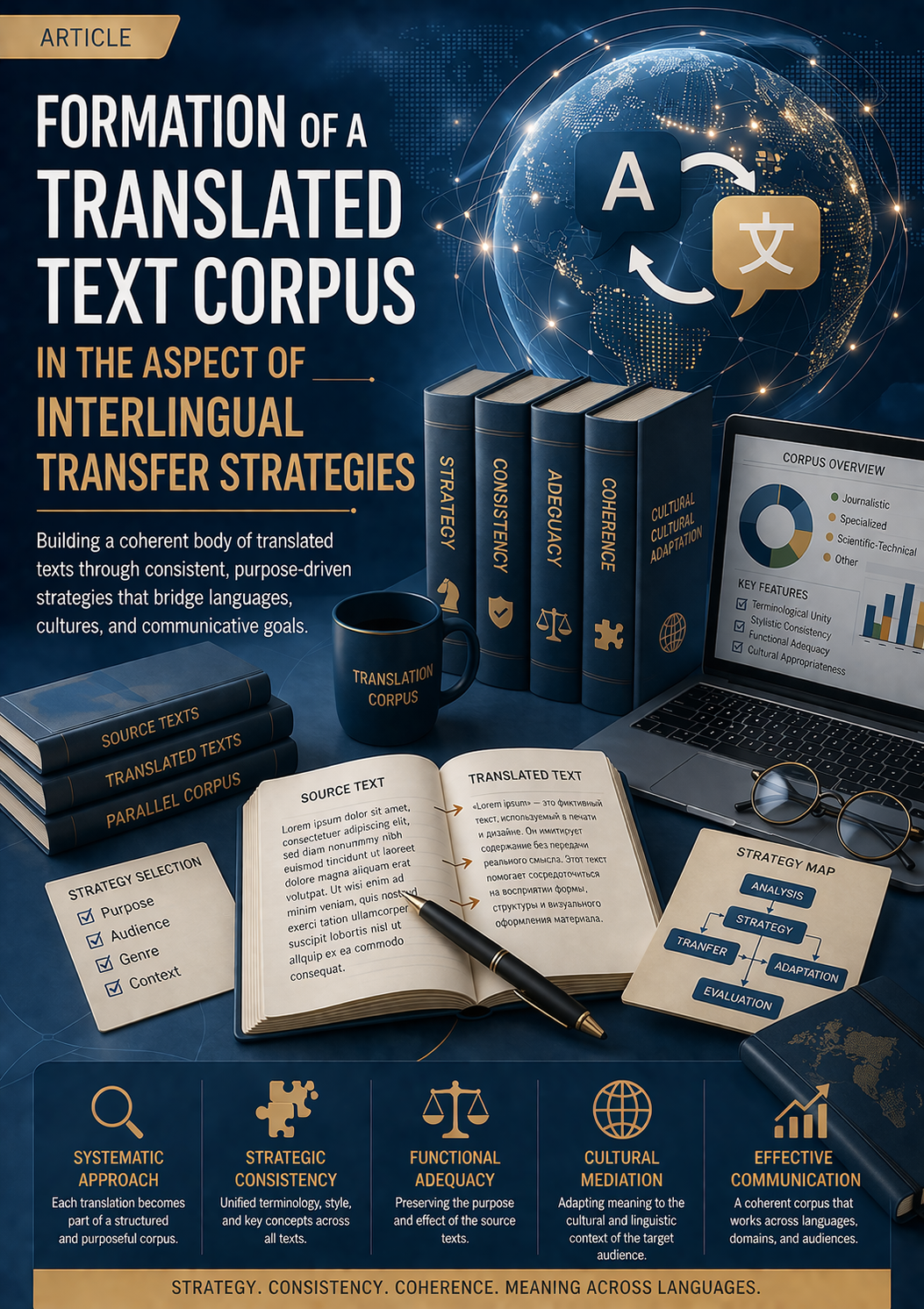
В современной переводоведческой науке всё большее внимание уделяется не только переводу отдельного текста, но и формированию целостного переводного текстового массива. Такой подход особенно актуален в условиях интенсивного межъязыкового обмена, когда перевод функционирует как системный инструмент передачи знаний, информации и культурных смыслов. Переводной текстовый массив представляет собой совокупность текстов, объединённых общей сферой функционирования, тематикой, коммуникативной задачей или типом дискурса. Его формирование требует не случайного набора переводческих решений, а продуманной системы стратегий межъязыковой передачи. Под стратегиями межъязыковой передачи понимаются общие принципы и способы перевода, с помощью которых обеспечивается перенос содержания, функций и структуры текста из одного языка в другой. Эти стратегии охватывают не только лексический и грамматический уровни, но и прагматический, стилистический и культурный аспекты. Именно поэтому формирование переводного массива невозможно без системного подхода: каждый отдельный перевод должен рассматриваться как часть более широкой текстовой организации. Одним из ключевых условий формирования переводного текстового массива является последовательность стратегий. Если тексты переводятся в рамках одной тематической области или одного функционального пространства, необходимо сохранять терминологическое единство, стилистическую согласованность и общую модель передачи ключевых понятий. Например, в научных и специальных текстах особое значение имеют точность терминологии, логическая ясность и однозначность. В публицистических текстах, напротив, важно учитывать воздействующую функцию, экспрессивность и прагматическую направленность высказывания. Следовательно, выбор стратегии определяется функциональной природой текста, но в пределах всего массива он должен быть внутренне согласованным. Формирование переводного массива также связано с принципом функциональной адекватности. Перевод должен сохранять не только содержание оригинала, но и его назначение в коммуникативной ситуации. Это означает, что стратегии межъязыковой передачи подбираются в зависимости от того, должен ли текст информировать, убеждать, объяснять, регламентировать или инструктировать. Таким образом, переводчик ориентируется не на формальное сходство языковых единиц, а на воспроизведение функции текста в иной языковой среде. Не менее важно учитывать, что переводной текстовый массив формируется на пересечении языковой и культурной систем. Поэтому стратегии межъязыковой передачи нередко включают адаптацию, экспликацию, компрессию, терминологическую унификацию и другие способы, позволяющие сделать текст понятным и уместным для адресата перевода. При этом особенно значима системность таких решений: только она обеспечивает целостность и профессиональную завершённость всего массива. Таким образом, формирование переводного текстового массива в аспекте стратегий межъязыковой передачи представляет собой сложный и многоуровневый процесс. Его успешная реализация зависит от способности переводчика сочетать точность, функциональную адекватность, стилистическую согласованность и культурную уместность. Именно стратегии межъязыковой передачи превращают совокупность отдельных переводов в целостную систему текстов, эффективно функционирующую в межъязыковой коммуникации. In modern translation studies, increasing attention is paid not only to the translation of an individual text, but also to the formation of an integral translated text corpus. This approach is especially relevant in the context of intensive interlingual exchange, where translation functions as a systematic instrument for transmitting knowledge, information, and cultural meanings. A translated text corpus can be understood as a body of texts united by a common sphere of functioning, subject matter, communicative task, or discourse type. Its formation requires not a random set of translation decisions, but a well-considered system of interlingual transfer strategies. Interlingual transfer strategies are understood as general principles and methods of translation by means of which the content, functions, and structure of a text are transferred from one language into another. These strategies cover not only the lexical and grammatical levels, but also pragmatic, stylistic, and cultural aspects. For this reason, the formation of a translated corpus is impossible without a systematic approach: each individual translation must be viewed as part of a broader textual organization. One of the key conditions for forming a translated text corpus is the consistency of strategies. If texts are translated within the same thematic field or functional space, it is necessary to preserve terminological unity, stylistic consistency, and a common model for rendering key concepts. For example, in scientific and specialized texts, terminological precision, logical clarity, and unambiguity are of particular importance. In journalistic texts, by contrast, it is essential to take into account the persuasive function, expressiveness, and pragmatic orientation of the statement. Therefore, the choice of strategy is determined by the functional nature of the text, but within the corpus as a whole it must remain internally coordinated. The formation of a translated corpus is also connected with the principle of functional adequacy. Translation must preserve not only the content of the original, but also its purpose in the communicative situation. This means that interlingual transfer strategies are selected depending on whether the text is intended to inform, persuade, explain, regulate, or instruct. Thus, the translator is guided not by the formal similarity of linguistic units, but by the reproduction of the text’s function in a different linguistic environment. It is equally important to take into account that a translated text corpus is formed at the intersection of linguistic and cultural systems. For this reason, interlingual transfer strategies often include adaptation, explicitation, compression, terminological unification, and other methods that make the text understandable and appropriate for the target audience. At the same time, the systematic nature of such decisions is particularly significant: only this ensures the integrity and professional completeness of the corpus as a whole. Thus, the formation of a translated text corpus in the aspect of interlingual transfer strategies is a complex and multi-level process. Its successful implementation depends on the translator’s ability to combine precision, functional adequacy, stylistic consistency, and cultural appropriateness. It is precisely interlingual transfer strategies that transform a set of individual translations into an integral system of texts functioning effectively in interlingual communication.
Адрес:
Телефон:
Email:
Сайт:
Информация
Посетители, находящиеся в группе Гости, не могут оставлять комментарии к данной публикации.