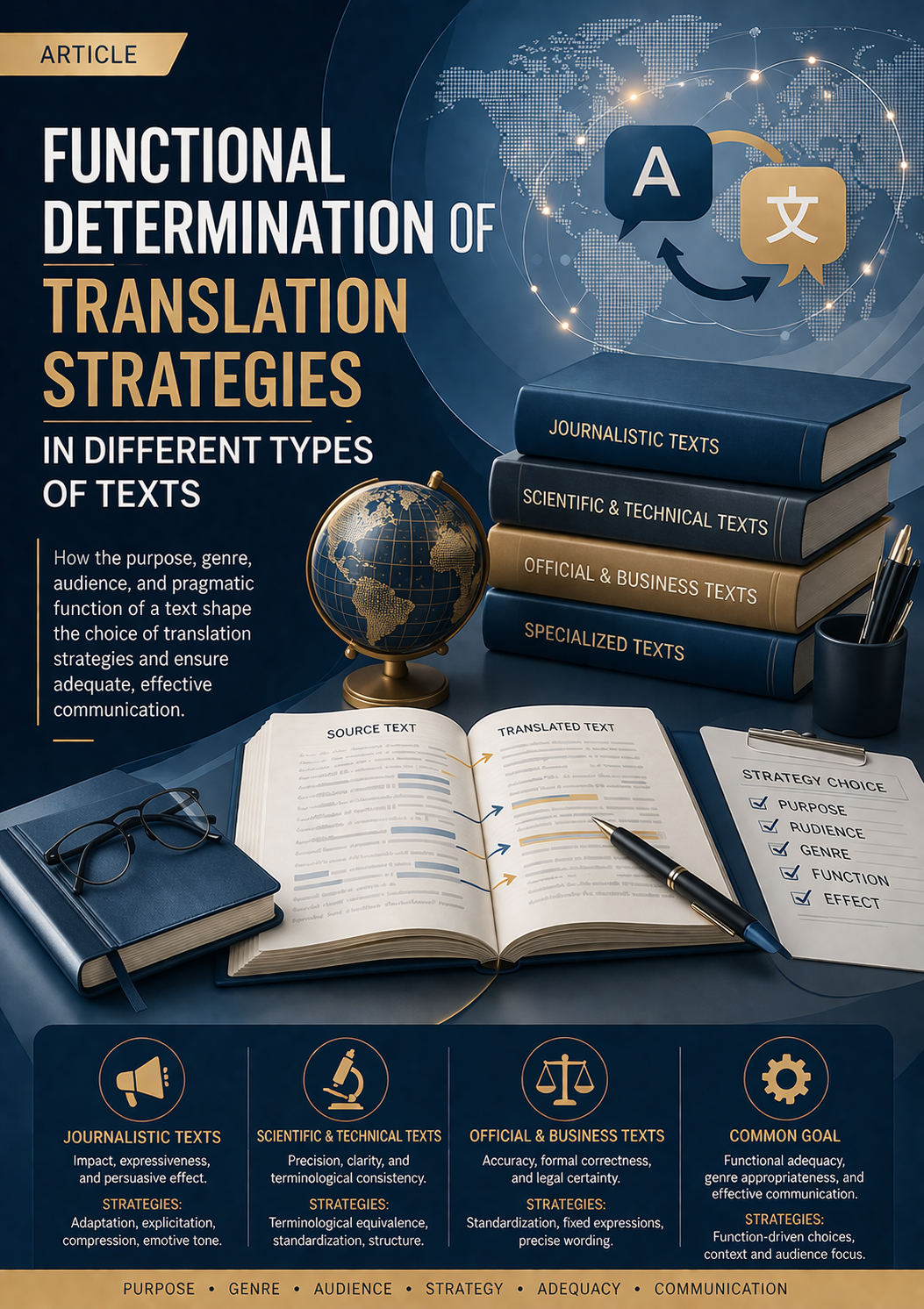
В современной теории перевода всё более значимым становится функциональный подход, согласно которому выбор переводческих стратегий определяется не только языковой формой исходного текста, но прежде всего его назначением, коммуникативной задачей и ожидаемым воздействием на адресата. Иными словами, переводчик работает не с абстрактным набором слов и конструкций, а с текстом как с единицей общения, включённой в конкретную ситуацию. Именно поэтому переводческие стратегии в разнотипных текстах не могут быть универсальными: они зависят от функции текста и от того, какую роль он выполняет в речевой практике. Функциональная обусловленность переводческих стратегий означает, что переводчик выбирает способы передачи текста, исходя из его жанровой природы, целевой аудитории, стилистических особенностей и прагматической установки. Один и тот же языковой элемент может быть переведён по-разному в зависимости от того, встречается ли он в научной статье, газетной публикации, технической инструкции или официальном документе. Следовательно, переводческое решение всегда связано не только с лексическим значением единицы, но и с её функцией в структуре целого текста. Особенно наглядно это проявляется при сопоставлении текстов разных функциональных типов. Так, в публицистических текстах основную роль играют информативная и воздействующая функции. Здесь важно сохранить не только факты, но и оценочность, экспрессивность, актуальность и убедительность высказывания. Поэтому переводчик нередко прибегает к стратегиям прагматической адаптации, экспликации, смысловой компрессии и сохранения эмоционально-оценочной окраски. Главная цель заключается в том, чтобы перевод вызывал у читателя реакцию, сопоставимую с реакцией адресата оригинала. Иная ситуация характерна для специальных и научно-технических текстов. Их основная функция — передача точной, логически организованной и профессионально значимой информации. В таких текстах переводческая стратегия подчиняется требованиям однозначности, терминологической последовательности, структурной ясности и соответствия нормам профессионального дискурса. Переводчик должен минимизировать двусмысленность, избегать неоправданной образности и следовать принципу функциональной точности. Здесь приоритет имеют стратегии терминологической эквивалентности, стандартизации и синтаксической упорядоченности. В официально-деловых текстах функциональная обусловленность проявляется ещё строже. Эти тексты служат для регламентации отношений, фиксации правовых норм, оформления договорных и административных процедур. Следовательно, перевод должен быть максимально точным, формально корректным и юридически однозначным. В этом случае переводческие стратегии ориентированы на сохранение клишированных конструкций, точность формулировок и нормативность языка. Таким образом, функциональная обусловленность переводческих стратегий в разнотипных текстах подтверждает, что перевод является не просто языковой операцией, а сложной коммуникативной деятельностью. Успешный перевод требует от переводчика умения определить доминирующую функцию текста и подчинить ей выбор языковых средств. Именно функциональный подход позволяет обеспечить адекватность перевода, его жанровую уместность и эффективность в новой языковой среде. In modern translation theory, the functional approach is becoming increasingly significant. According to this approach, the choice of translation strategies is determined not only by the linguistic form of the source text, but above all by its purpose, communicative task, and the expected effect on the recipient. In other words, the translator works not with an abstract set of words and structures, but with the text as a unit of communication embedded in a specific situation. This is why translation strategies in different types of texts cannot be universal: they depend on the function of the text and the role it performs in communicative practice. The functional determination of translation strategies means that the translator chooses ways of rendering the text on the basis of its genre, target audience, stylistic features, and pragmatic orientation. The same linguistic element may be translated differently depending on whether it appears in a scientific article, a newspaper publication, a technical instruction, or an official document. Therefore, a translation decision is always connected not only with the lexical meaning of a unit, but also with its function within the structure of the whole text. This is especially evident when comparing texts of different functional types. In journalistic texts, for example, the informative and persuasive functions play the main role. Here, it is important to preserve not only facts, but also evaluative meaning, expressiveness, topicality, and persuasiveness of the statement. For this reason, the translator often resorts to strategies of pragmatic adaptation, explicitation, semantic compression, and preservation of emotional and evaluative coloring. The main goal is to ensure that the translation evokes in the reader a reaction comparable to that of the recipient of the original. A different situation is characteristic of specialized and scientific-technical texts. Their main function is to convey precise, logically organized, and professionally significant information. In such texts, the translation strategy is subordinated to the requirements of unambiguity, terminological consistency, structural clarity, and conformity to the norms of professional discourse. The translator must minimize ambiguity, avoid unjustified imagery, and follow the principle of functional precision. Here, priority is given to strategies of terminological equivalence, standardization, and syntactic orderliness. In official-business texts, functional determination is manifested even more strictly. These texts serve to regulate relations, record legal norms, and formalize contractual and administrative procedures. Consequently, the translation must be максимально precise, formally correct, and legally unambiguous. In this case, translation strategies are oriented toward preserving formulaic constructions, accuracy of wording, and the normative character of the language. Thus, the functional determination of translation strategies in different types of texts confirms that translation is not merely a linguistic operation, but a complex communicative activity. Successful translation requires the translator to identify the dominant function of the text and subordinate the choice of linguistic means to it. It is precisely the functional approach that makes it possible to ensure the adequacy of translation, its genre appropriateness, and its effectiveness in a new linguistic environment.
Адрес:
Телефон:
Email:
Сайт:
Информация
Посетители, находящиеся в группе Гости, не могут оставлять комментарии к данной публикации.